The Short Answer
If you want one instruction, take it from the source that decides half the question. In its guide to optimizing for generative AI features, last updated on 10 July 2026, Google states that "optimizing for generative AI search is optimizing for the search experience, and thus still SEO."
The same page says you do not need special structured data, you do not need to chunk your content, and you do not need to write differently for machines.
That is an unsatisfying answer for anyone hoping to buy a shortcut, and it is the accurate one. What has genuinely changed is not the technique but the payoff: fewer people click, so the citation itself is now the visibility.
What the Click Data Shows
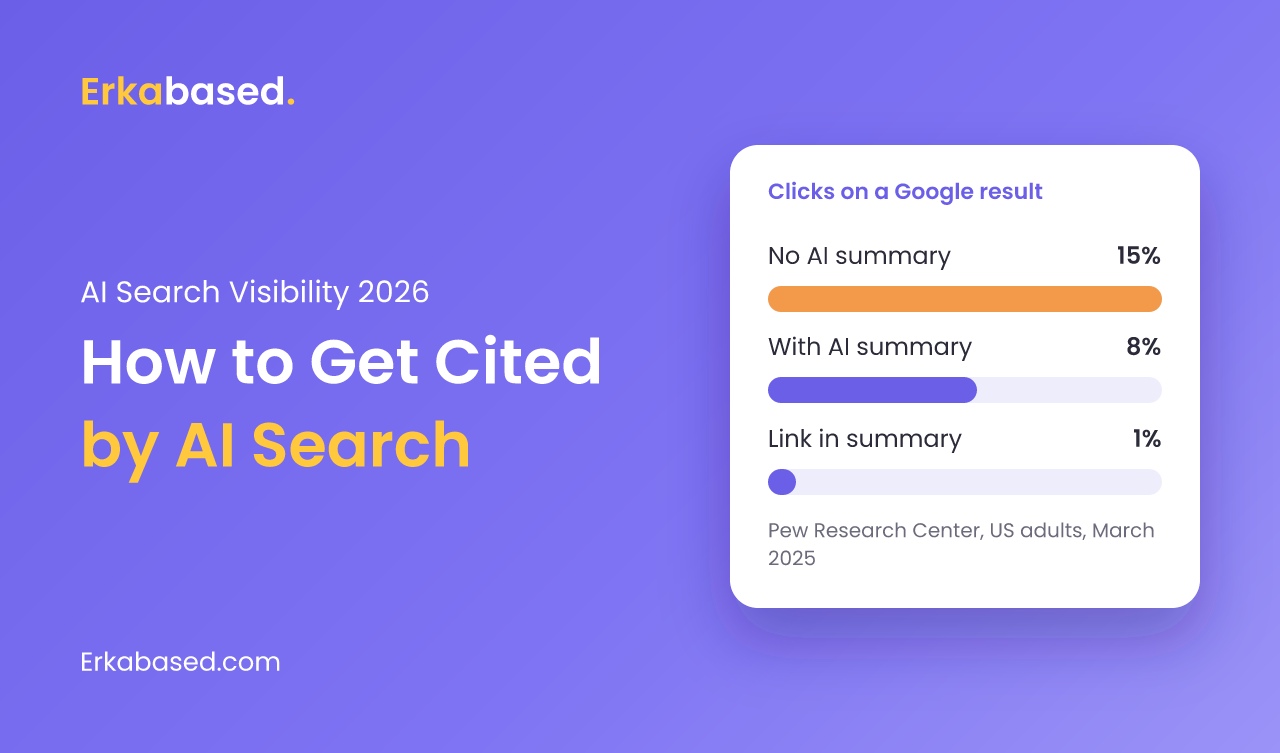
The most methodologically transparent study is from the Pew Research Center, published 22 July 2025. It tracked the real browsing of 900 US adults across 68,879 searches in March 2025, of which 12,593 returned an AI summary. The results:
| Behaviour on a Google results page | With an AI summary | Without |
|---|---|---|
| Clicked a traditional search result | 8% of visits | 15% of visits |
| Clicked a link inside the AI summary | 1% of visits | — |
| Ended the browsing session there | 26% of visits | 16% of visits |
Ahrefs reached a similar direction from a different angle. Comparing 150,000 keywords that trigger AI Overviews with 150,000 that do not, it reported a 34.5% lower click-through rate at position one in April 2025, and 58% in its February 2026 re-run. Read these as modelled counterfactuals from a company that sells SEO tooling, not as measured causation. Ahrefs says so itself.
How Much Traffic AI Sends
Less than the discourse implies, and it lands in unexpected places. According to Similarweb data reported by Search Engine Journal on 30 July 2026:
- Search still had about 3.3 billion monthly unique visitors against roughly 655 million for chatbots.
- 461 million of ChatGPT's 494 million users, about 95%, also used Google between March and May 2026. These are overlapping habits, not a migration.
- Only 6.8% of US ChatGPT answers included an external link in May 2026, up from roughly 1%.
- 65% of cited URLs sat two or three folders deep, while 58.8% of AI referral traffic landed on a homepage.
The crawl-to-referral imbalance is starker. Cloudflare measured HTML requests per HTML referral across its network between 19 and 26 June 2025 and reported roughly 70,900 requests per referral for Anthropic and about 0.1 for Mistral.
Cloudflare notes the caveat that Claude's native app sends no referrer header, so the ratio overstates the gap. The honest summary: AI assistants read far more than they send back, and that asymmetry is structural.
The Crawlers That Gate Citations
This is the part most teams get wrong, because blocking the training crawler and blocking the citation crawler are different decisions with the same-looking syntax.
| User agent | What it does | Effect of blocking it |
|---|---|---|
| GPTBot | OpenAI model training | Your content is not used for training; ChatGPT search is unaffected |
| OAI-SearchBot | Surfaces sites in ChatGPT's search features | Per OpenAI, opted-out sites will not be shown in ChatGPT search answers |
| ClaudeBot | Anthropic training crawl | Content excluded from training; supports Disallow and Crawl-delay |
| Claude-SearchBot | Indexing for Claude's search | Per Anthropic, prevents indexing your content for search |
| PerplexityBot | Surfaces and links sites in Perplexity results | You disappear from Perplexity results; it is not a training crawler |
| Google-Extended | Gemini training and grounding | Google states it does not affect inclusion in Google Search or ranking |
Three practical consequences. First, if you block everything with a blanket rule, you have removed yourself from AI answers while gaining nothing on the training question you actually cared about — check the OpenAI, Anthropic and Perplexity documentation for the exact tokens.
Second, user-initiated fetchers behave differently: OpenAI says robots.txt rules may not apply to ChatGPT-User, and Perplexity says Perplexity-User generally ignores robots.txt. Third, Google-Extended is not an AI Overviews opt-out; for that, Google's AI features documentation points to nosnippet, data-nosnippet, max-snippet and noindex.
What Does Not Work
Google's optimization guide is unusually blunt about the current crop of tactics, and it is worth quoting rather than paraphrasing.
- llms.txt. On these files, Google writes that adding one "will neither harm nor help your site's visibility or rankings in Google Search, as Google Search ignores them." The llms.txt specification site itself claims only that thousands of sites publish one and that AI labs publish them for their own developer documentation — not that any assistant reads yours when answering a question. No AI vendor's own documentation that we could open says its systems consume your llms.txt.
- Special AI markup. Google states there is no special schema.org structured data you need to add, and no machine-readable AI text file requirement.
- Content at scale. Generating many near-identical pages violates Google's scaled content abuse policy.
- Buying mentions. Google's wording: "Seeking inauthentic 'mentions' across the web isn't as helpful as it might seem."
How to Get Cited by AI Search
- Serve your text in the HTML. If the content only appears after JavaScript runs, you are relying on every retrieval system rendering it. Server-rendered content removes that dependency, which is one of the reasons we build the way we describe in why frontend matters.
- Answer one question per page, in the first two paragraphs. Retrieval favours passages that stand alone. Pew found that 60% of the searches producing AI summaries were questions, and 53% of ten-word-plus queries triggered one.
- Make your facts quotable. Put figures in tables with units and dates, and attribute them to a named source. An assistant cannot cite a claim it cannot attribute.
- Write FAQ answers that survive being extracted. Two or three sentences that name the subject, with no dependency on the paragraph above.
- Keep deep pages strong. Since 65% of cited URLs sit two or three folders deep, your detailed guides matter more than your homepage for citation, even though the homepage receives most of the referral traffic.
- Fix the basics. Google lists crawlable pages, unblocked JavaScript, semantic HTML, and good page experience among the things that do help — the ground covered in Core Web Vitals.
- Measure it. Segment AI referrers in your analytics so the discussion runs on your own numbers rather than industry averages; our Google Analytics guide covers the setup.
Conclusion
AI search has not replaced search. Similarweb's panel data shows chatbot visits growing about 70% year on year, while the overwhelming majority of those users still search too.
What it has done is raise the cost of being unremarkable. Pages that merely restate what everyone else says now get summarised away; pages with original figures, clear structure, and verifiable sources get named. That is the same discipline good publishing always required, with a sharper penalty for skipping it.
Sources
- Google users are less likely to click on links when an AI summary appears in the results — Pew Research Center, 22 July 2025
- AI Overviews Reduce Clicks by 58% — Ahrefs, 4 February 2026
- AI Overviews Reduce Clicks by 34.5% — Ahrefs, 17 April 2025
- AI Search Isn't Replacing Google, It's Layering On Top – Similarweb Data — Search Engine Journal, 30 July 2026
- AI Search Stats 2026 — Similarweb, 29 July 2026
- The crawl before the fall… of referrals — Cloudflare, 1 July 2025
- Google's Guide to Optimizing for Generative AI Features on Google Search — Google Search Central, 10 July 2026
- AI Features and Your Website — Google Search Central, checked 18 September 2026
- Google crawlers overview — Google Search Central, checked 18 September 2026
- OpenAI bots — OpenAI, checked 18 September 2026
- Does Anthropic crawl data from the web, and how can site owners block the crawler? — Anthropic Help Center, checked 18 September 2026
- PerplexityBot — Perplexity, checked 18 September 2026
- The /llms.txt file — llmstxt.org, modified 10 August 2026
Frequently Asked Questions
Does adding an llms.txt file help my site get cited by AI?
There is no first-party evidence that it does. Google's optimization guide states that adding one will neither harm nor help visibility or rankings in Google Search, because Google Search ignores these files. The llms.txt specification site claims only that many sites publish one, not that any assistant reads yours when answering questions.
Which crawler decides whether ChatGPT can cite my website?
OAI-SearchBot, not GPTBot. OpenAI's documentation says GPTBot is the training crawler, while OAI-SearchBot surfaces websites in ChatGPT's search features, and sites opted out of OAI-SearchBot will not be shown in ChatGPT search answers. Blocking the wrong one removes you from answers without changing training.
How much do AI Overviews reduce clicks?
Pew Research Center tracked real browsing by 900 US adults in March 2025 and found users clicked a traditional result on 8% of visits with an AI summary versus 15% without, and clicked a link inside the summary on just 1% of visits. Ahrefs separately modelled a 58% lower click-through rate at position one in February 2026.
Does blocking Google-Extended remove my site from AI Overviews?
No. Google's crawler documentation states that Google-Extended does not impact a site's inclusion in Google Search nor is it used as a ranking signal, because it governs Gemini training and grounding. To control AI Overviews snippets, Google points to nosnippet, data-nosnippet, max-snippet and noindex instead.
Do I need special schema markup to appear in AI answers?
No. Google's guide to generative AI features states there is no special schema.org structured data you need to add and no machine-readable AI text file requirement. Standard structured data still helps normal search features, but it is not an AI-specific requirement.
Is it worth optimizing for AI search if it sends so little traffic?
It depends on what you sell. Search still had roughly 3.3 billion monthly unique visitors against about 655 million for chatbots, and only 6.8% of US ChatGPT answers included an external link in May 2026. The work is worth doing because it is the same work classic search rewards, not because AI referrals alone will replace your traffic.
At Erkabased, we build sites where the important text ships in the server-rendered HTML, structured data is generated from real content, and the sitemap and robots rules are configured deliberately rather than inherited from a template. If your traffic is falling and you are not sure whether the cause is technical or editorial, we can look before you rebuild. Contact us, or see how we work on our software house page.