What a Custom Web App Costs
There is no single price, and any agency that quotes one before understanding your workflows is guessing. What exists is published market data.
Clutch, which lists thousands of development firms, reported on 18 September 2026 that most software development companies on its platform charge between $24 and $49 per hour, with an average project cost of $132,480.29 and an average timeline of about 13 months.
Those averages cover everything from a four-week internal tool to a multi-year platform, so treat them as a reference point rather than a forecast. The figure that matters more is the spread: rate bands on the same directory run from under $25 per hour to more than $200 per hour. That is the gap you need to explain before you sign anything.
Why Quotes Differ So Much
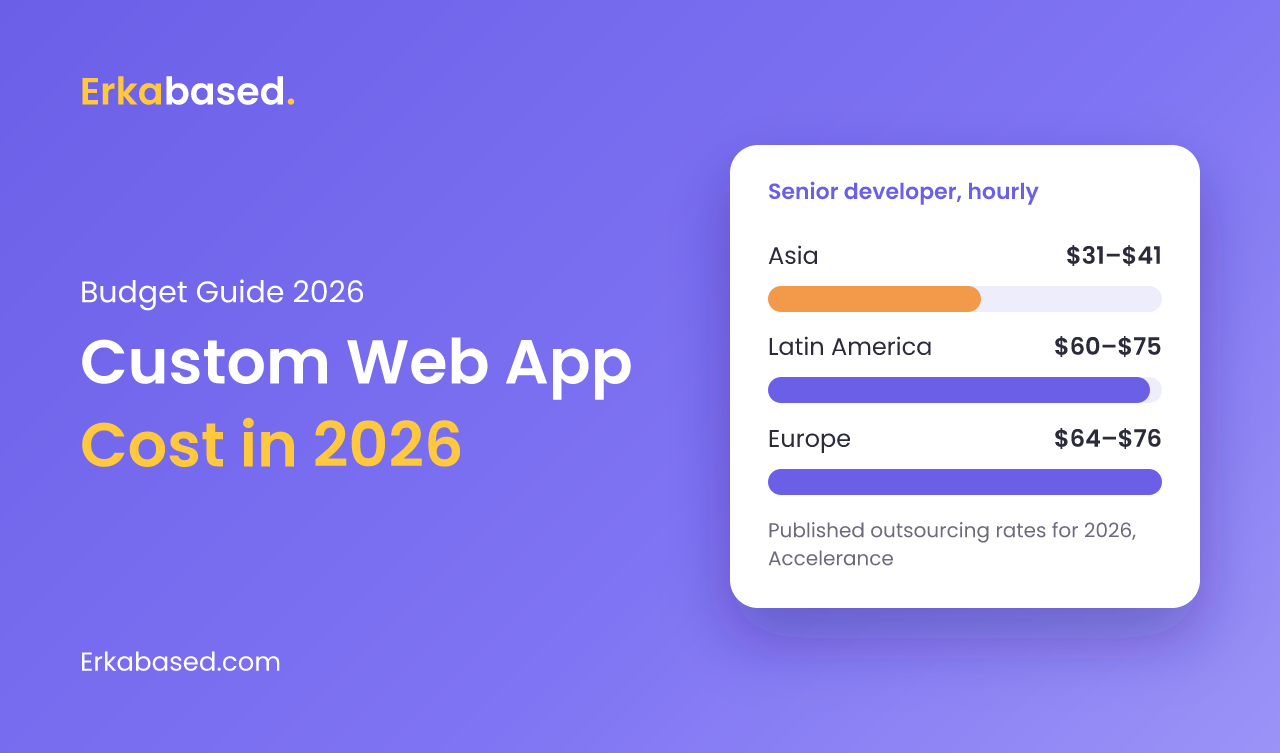
Most of the difference is geography and seniority, not quality. Accelerance published 2026 outsourcing rate ranges on 24 November 2025:
| Region | Junior, per hour | Senior, per hour | Change in 2025 |
|---|---|---|---|
| Asia | $24–$31 | $31–$41 | about −8% |
| Latin America | $33–$45 | $60–$75 | −7.1% |
| Europe | $31–$39 | $64–$76 | −4.4% |
Compare that with in-house cost. The U.S. Bureau of Labor Statistics reports a median annual wage for software developers of $135,980 as of May 2025, or $64.44 per hour, with the top 10% above $214,670. That is salary alone, before benefits, recruiting, equipment, and management.
The 2025 Stack Overflow Developer Survey shows the same pattern across countries: a median engineering manager reported $200,000 in the United States, $136,141 in the United Kingdom, $118,335 in Germany, and $52,308 in India.
Three Pricing Models Compared
| Model | How you pay | Fits when | Main risk to you |
|---|---|---|---|
| Fixed price | One agreed total for an agreed scope | Scope is genuinely settled: a marketing site, a defined integration | Change requests become expensive; the team is paid to say no |
| Time and materials | Hours worked, billed monthly | Discovery, evolving products, anything with unknowns | No ceiling unless you set one in the contract |
| Dedicated team | Monthly fee per person | Continuous roadmap over several months or longer | You pay for capacity even in slow months |
Fixed price does not remove risk; it prices it. A vendor accepting a fixed total for a vague brief adds a buffer, and you pay for that buffer whether or not it is needed.
A practical middle path is a small paid discovery phase with a fixed price, followed by time and materials against the specification it produces. Our walkthrough of the software development life cycle covers what that discovery should deliver.
What Actually Drives the Number
Screens are the cheap part. Cost concentrates in the things a demo never shows:
- Roles and permissions. "Admins see everything, staff see their own records" is one sentence in a brief and a permanent constraint in every query, endpoint, and test that follows.
- Integrations you do not control. Accounting software, shipping carriers, payment providers, and legacy databases each come with their own authentication, rate limits, sandbox quirks, and outages.
- Data migration. Moving years of spreadsheets into a relational schema means reconciling duplicates, missing fields, and records that contradict each other. Budget it as its own milestone.
- Compliance and audit trails. Who changed what, when, and can you prove it a year later.
- Reporting. Business owners ask for "a simple dashboard" and mean a reporting layer over data that was never structured for reporting.
Ask for these as estimated developer-days and multiply by a rate from the table above. That turns a mystery total into arithmetic you can question line by line. The technology choice matters too, but less than most vendors imply. We discuss the trade-offs in choosing the right technology stack.
The Running Costs Nobody Quotes
A build price is not a total cost of ownership. These are published list prices for services a typical web app relies on, all checked on 18 September 2026:
| Service | Entry price | What pushes it up |
|---|---|---|
| [Vercel](https://vercel.com/pricing) hosting | Pro at $20 per month | 1 TB transfer included, then from $0.15 per GB; functions from $0.60 per 1M |
| [Supabase](https://supabase.com/pricing) database | Pro from $25 per month | 100,000 monthly active users, 8 GB disk, 250 GB egress included; egress $0.09 per GB after |
| [Clerk](https://clerk.com/pricing) authentication | Pro at $25 per month | 50,000 monthly users included, then $0.02 each; SAML/SSO $75 per connection per month |
| [Stripe](https://stripe.com/pricing) payments | 2.9% + 30¢ per successful domestic card charge | +1.5% for international cards, +1% when currency conversion is required |
Note the shape of these: cheap while you are small, and tied to usage once you grow. A payment fee of 2.9% plus 30¢ is invisible on ten orders a month and is a line item worth engineering around at ten thousand. Add maintenance on top: dependency updates, security patches, browser changes, and the fixes that follow real usage.
What the Overrun Research Shows
The largest published dataset on this question is a study of 5,392 IT projects across more than 66 countries, totalling USD 56.5 billion in spend, published as a preprint on 26 August 2022 and in the Journal of Management Information Systems. Its findings are more useful than the folklore:
- The median cost-overrun ratio was 1.0, meaning the typical project landed on budget. The authors write that there is a strong tendency for IT projects to be on budget.
- The mean ratio was 1.8 with a standard deviation of 8.5 and a maximum of 280.4. The authors argue the average overrun for IT projects effectively cannot be calculated, because the distribution has a fat tail.
- One project in the dataset was budgeted at USD 1,500 and finished at USD 425,000.
- Estimates in the dataset typically included little contingency, up to 15%.
The practical reading: most projects are fine, and the ones that fail do not fail by 20%. They fail by multiples. That risk lives in scope, not in hourly rates. Shipping a narrow first version and expanding it is the cheapest insurance available, which is the argument behind MLP and MVP approaches.
How to Read a Cheap Quote
- Ask what is excluded. Design, testing, data migration, deployment, documentation, and post-launch fixes are the usual omissions.
- Ask who writes the code. A low rate quoted by a team that subcontracts to a fourth party means nobody owns the outcome.
- Ask for the hours behind each milestone. A total with no hours cannot be compared with another total.
- Ask who owns the repository and the accounts. Code, domain, hosting, and database accounts should be in your name from day one.
- Ask what happens after launch. Get the support terms in writing before you sign, not after the first bug.
- Ask to talk to a client from a finished project, ideally one similar in size to yours.
Conclusion
Custom web app cost in 2026 is a function of three things you can actually inspect: the rate, the hours, and the scope. Published data gives you the rate, an honest vendor gives you the hours, and disciplined scoping protects you from the only failure mode that really hurts.
If your project is a redesign rather than a new build, our guide to calculating the cost of revamping a website works through the same arithmetic from the other direction.
Sources
- Software Development Company Pricing Guide September 2026 — Clutch, 18 September 2026
- 2026 Outsourcing Rates: Global Costs Are Trending Down — Accelerance, 24 November 2025
- Software Developers, Quality Assurance Analysts, and Testers — U.S. Bureau of Labor Statistics, 27 August 2026
- Work | 2025 Stack Overflow Developer Survey — Stack Overflow, 2025 edition
- The Empirical Reality of IT Project Cost Overruns: Discovering A Power-Law Distribution — Journal of Management Information Systems (preprint), 26 August 2022
- Pricing — Vercel, checked 18 September 2026
- Pricing & Fees — Supabase, checked 18 September 2026
- Pricing — Stripe, checked 18 September 2026
- Pricing — Clerk, checked 18 September 2026
Frequently Asked Questions
How much does it cost to build a custom web app in 2026?
There is no single answer, but published market data gives a reference point. Clutch reported in September 2026 that most development companies on its platform charge between $24 and $49 per hour, with an average project cost of $132,480.29 over about 13 months. Your own figure depends on scope, integrations, and where your team is based.
Why do software development quotes vary so much for the same brief?
Mostly geography and seniority. Accelerance published 2026 senior developer rates of $31–$41 per hour in Asia, $60–$75 in Latin America, and $64–$76 in Europe, while the U.S. Bureau of Labor Statistics puts the median American software developer wage at $64.44 per hour before benefits. The rest of the variance comes from what each vendor silently includes or excludes.
Is fixed price or time and materials better for a web app?
Fixed price suits genuinely settled scope and shifts change-request risk onto you. Time and materials suits products with unknowns and needs a contractual ceiling to stay safe. A common compromise is a fixed-price discovery phase followed by time and materials against the specification it produces.
Do most software projects go over budget?
Not by the typical measure. A study of 5,392 IT projects published in 2022 found a median cost-overrun ratio of 1.0, meaning the typical project landed on budget. The danger is the tail: the same dataset recorded a maximum overrun ratio of 280.4, and the authors argue the average overrun cannot meaningfully be calculated.
What ongoing costs should I budget after launch?
Hosting, database, authentication, payment fees, and maintenance. As of 18 September 2026, published entry prices include Vercel Pro at $20 per month, Supabase Pro from $25 per month, Clerk Pro at $25 per month, and Stripe at 2.9% plus 30¢ per successful domestic card charge. These scale with usage, so model them at your expected volume rather than at launch volume.
What should I ask before accepting a low quote?
Ask what is excluded, who writes the code, how many hours sit behind each milestone, who owns the repository and hosting accounts, and what support looks like after launch. A total with no hours behind it cannot be compared with any other total.
At Erkabased, we scope before we quote: we map your workflows, break the build into milestones with estimated hours, and tell you which parts you do not need yet. Websites typically take 2-4 weeks and web apps 4-12 weeks, and you own the code and the accounts from the first commit. Contact us to talk through your project, or see how we work on our software house page.