Why Traffic Does Not Become Leads
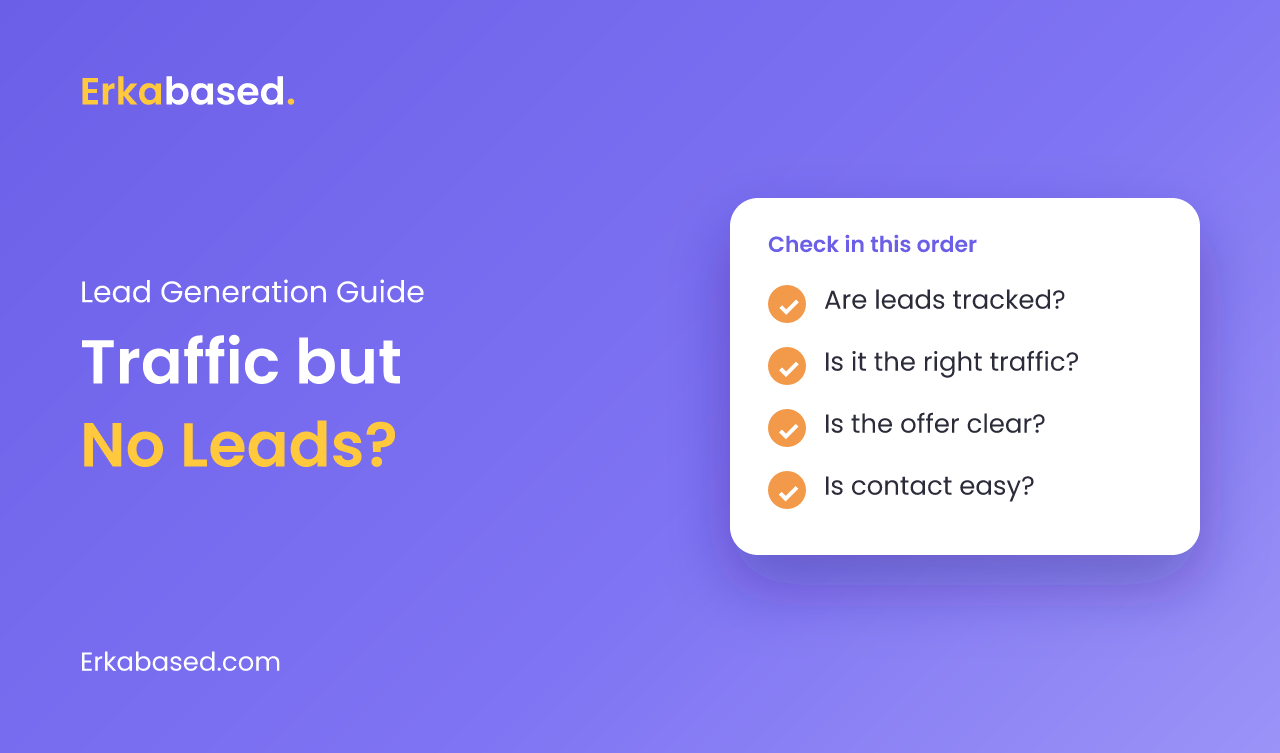
When a website gets visitors but no enquiries, the cause is almost always one of five things: leads are not being counted, the traffic is the wrong kind, the offer is unclear, the site is slow on phones, or contacting you takes too much effort. Each has a different fix, so diagnose before you redesign.
This guide walks through the five checks in the order that saves the most time, using free tools from Google, and ends with a one-week plan you can hand to your team or your web partner.
Step 1: Make Sure Leads Are Counted
Before fixing the site, confirm the problem is real. Many businesses do get leads from their website but cannot see them, because the enquiry happens on WhatsApp, by phone, or by email.
- Mark your lead actions as key events in Google Analytics 4: form submissions, WhatsApp button clicks, phone link clicks, and email link clicks. Google's help page explains how to create them.
- Ask new customers where they found you and record the answer.
- Use a separate WhatsApp number or pre-filled message for the website, so website chats are recognizable.
If you have not set up analytics properly yet, start with our guide to using Google Analytics for growth.
Step 2: Check Which Traffic You Attract
Open the Performance report in Google Search Console and look at the Queries tab. It shows the searches your site appeared for, with clicks, impressions, and average position. The question is whether those searches come from potential buyers.
| Type of query | Example | What the visitor wants | What the page should do |
|---|---|---|---|
| Informational | what is an ERP | To learn | Teach, then point to a relevant service |
| Comparison | custom ERP vs off-the-shelf | To decide | Compare honestly, then invite a conversation |
| Commercial | ERP development company | To hire | Show proof, process, and a clear way to contact |
| Local | software house near me | To hire nearby | Show location, service area, and contact details |
If most clicks come from informational queries, your traffic is real but early in the buying journey. The fix is not a new design; it is a path from each article to the relevant service page, and more pages aimed at comparison and commercial searches.
Step 3: Say What You Do in 10 Seconds
Jakob Nielsen of Nielsen Norman Group found that "users often leave Web pages in 10–20 seconds", and that to hold attention "you must clearly communicate your value proposition within 10 seconds".
Test your home page and main service pages against three questions a visitor asks at once:
- What do you offer? In plain words, not a slogan.
- Is it for someone like me? Name the audience or the industry.
- What do I do next? One visible button, above the fold.
If the answers are not obvious within a few seconds, rewrite the headline before touching anything else. Our article on crafting a value proposition has a framework for this.
Step 4: Fix Speed on Mobile
A slow page loses visitors before they read the headline. Google's Core Web Vitals define what "good" means, measured at the 75th percentile of page loads:
| Metric | What it measures | Good threshold |
|---|---|---|
| Largest Contentful Paint (LCP) | Loading | 2.5 seconds or less |
| Interaction to Next Paint (INP) | Responsiveness | 200 milliseconds or less |
| Cumulative Layout Shift (CLS) | Visual stability | 0.1 or less |
Search Console includes a Core Web Vitals report for your own pages. For what to do about each metric, see mastering Core Web Vitals.
Step 5: Remove Friction From Contact
- Put a call to action on every page, including blog posts, not only on the contact page.
- Shorten the form to what you need for a first reply: name, contact, and a short message.
- Offer the channel your customers prefer, such as WhatsApp alongside the form.
- Say what happens next, for example "we reply within one working day".
- Show proof near the button: a case study, a client logo, or a short result.
Design choices like button contrast and layout affect this directly. We cover them in how UI/UX impacts your digital marketing.
A One-Week Fix Plan
| Day | Task | Output |
|---|---|---|
| 1 | Set up key events for forms, WhatsApp, phone, and email | Leads you can count |
| 2 | Review Search Console queries for the last three months | A list of buyer and non-buyer searches |
| 3 | Rewrite the headline and first screen of your top pages | A clear 10-second message |
| 4 | Check Core Web Vitals and fix the largest images and scripts | Faster mobile pages |
| 5 | Add calls to action and links from articles to service pages | Paths from reading to contacting |
After a month, compare key events with the month before. If leads rise, keep going. If traffic is simply too small or too informational, the next step is new content aimed at buyers, and making sure AI assistants can quote you too, as explained in how to get cited by AI search.
Conclusion
A website with traffic and no leads usually has a leak, not a curse. Count leads properly, check that the traffic comes from buyers, make the offer clear in ten seconds, keep pages fast on phones, and make contact effortless. Work through these in order and you will know exactly where the problem is before you spend money on a redesign.
Read next: if your website is fine but your operations are not, see when to move from spreadsheets to an ERP.
Sources
- How Long Do Users Stay on Web Pages? — Nielsen Norman Group, 11 September 2011
- Web Vitals — web.dev (Google), checked 19 September 2026
- Performance report (Search) — Google Search Console Help, checked 19 September 2026
- Create or modify key events — Google Analytics Help, checked 19 September 2026
Frequently Asked Questions
Why does my website get traffic but no leads?
Usually for one of five reasons: leads are not tracked, the traffic comes from searches by people who are not ready to buy, the offer is unclear, the site is slow on phones, or contacting you takes too much effort. Checking them in that order shows where the problem is before you redesign anything.
How do I track leads from my website?
Mark lead actions such as form submissions, WhatsApp clicks, phone clicks, and email clicks as key events in Google Analytics 4. Also ask new customers how they found you, and use a dedicated WhatsApp number or pre-filled message for website visitors.
How quickly do visitors decide to leave a website?
Nielsen Norman Group found that users often leave web pages in 10 to 20 seconds, and that a page must communicate its value proposition within about 10 seconds to hold attention. That is why the headline and first screen matter most.
What are good Core Web Vitals scores?
Google defines good scores as a Largest Contentful Paint of 2.5 seconds or less, an Interaction to Next Paint of 200 milliseconds or less, and a Cumulative Layout Shift of 0.1 or less, measured at the 75th percentile of page loads.
Should I redesign my website to get more leads?
Not before diagnosing the problem. Many sites with few leads need tracking, a clearer headline, faster mobile pages, and easier contact options rather than a full redesign. Fix those first and measure the result for a month.
At Erkabased, we build websites that generate leads and drive sales: fast, search-optimized pages with a clear offer and an easy way to reach you, typically in 2-4 weeks. If your current site gets visitors but no enquiries, we can review it with you and show where the leak is. See our services or contact us.