The Short Answer
Choose Odoo when your processes are close to standard practice and you are willing to adapt to the software. Choose a custom ERP when a workflow that makes you money does not fit any package, or when the integrations you depend on are the hard part. Many growing businesses end up with a mix of both.
This article compares the two using Odoo's published 2026 prices, explains what those prices leave out, and shows where customization quietly turns a packaged ERP into a custom project anyway. It ends with a checklist you can use in your next planning meeting.
What Odoo Costs in 2026
Odoo's pricing page lists three plans. Prices are shown in the visitor's local currency; the figures below are the ones displayed for Indonesia on 19 September 2026, per user per month.
| Plan | Billed yearly | Billed monthly | Key limits |
|---|---|---|---|
| One App Free | Rp0 | Rp0 | One app only, unlimited users |
| Standard | Rp137,500 (Rp110,000 first-year promo) | Rp170,000 (Rp136,000 promo) | All apps, Odoo Online only |
| Custom | Rp212,500 (Rp170,000 first-year promo) | Rp265,000 (Rp211,875 promo) | Adds Odoo Studio, multi-company, external API, Odoo.sh or on-premise |
For a team of 20 users on the Custom plan at the regular yearly rate, that is Rp51 million a year, or about $2,874 at Bank Indonesia's JISDOR rate of Rp17,745 per dollar on 18 September 2026. The subscription is predictable and, for many companies, good value.
What the Subscription Leaves Out
Odoo's own pricing page lists what is not included:
- Implementation services and access to Odoo expert services.
- Maintenance of custom code.
- Hosting on Odoo.sh for custom developments.
- In-app purchase credits, such as SMS and AI scanning of vendor bills and expenses.
Those items are where the real budget goes once a business has anything unusual about it.
Where Odoo Fits Well
- Standard processes. Quote, sell, invoice, receive stock, and pay suppliers the way most companies in your industry do.
- A team ready to adapt. You are happy to change how people work to match the software, rather than the other way around.
- Breadth over depth. You want CRM, accounting, inventory, HR, and a website in one place, and none of them has to be exceptional.
- Limited internal IT. A hosted subscription with upgrades included removes a lot of operational work.
Where a Custom ERP Makes Sense
A custom ERP earns its cost when the workflow itself is the competitive advantage, or when the messy part of the business sits between systems rather than inside one.
- Channel-specific logic. Different prices, fees, and payout rules for each sales channel.
- Reconciliation across platforms. Matching settlement reports from marketplaces or delivery apps back to the orders behind them.
- Unusual production. Recipes, batches, yields, or bundles that standard manufacturing modules model awkwardly.
- A user experience your staff will actually use, with only the screens they need.
Our Fitora case study is an example. The business sells through its own outlet and three food delivery apps. The hard part was not accounting; it was importing each platform's reports and matching payouts to orders, which a custom backoffice now does in under a minute.
The Hidden Cost of Customizing Odoo
Customization is where the comparison usually flips. According to Panorama Consulting Group's 2026 ERP Report, more than a quarter of organizations exceeded their ERP project budgets, and additional technology needs were the leading cause.
"Organizations often discover fatal misfits late in the project, so they turn to additional technology, scope expansion, and custom builds." Chris Devault, Panorama Consulting Group
On Odoo, deeper changes require the Custom plan, and custom code is outside what the subscription maintains. Every new Odoo release then becomes a small project: someone has to check and update your custom modules. If most of your requirements are custom modules, you are running a custom ERP on top of a framework, and paying for both.
Custom ERP vs Odoo Side by Side
| Factor | Odoo | Custom ERP |
|---|---|---|
| Upfront cost | Low: subscription plus implementation | Higher: design and build before go-live |
| Ongoing cost | Per user, per month, rising with headcount | Hosting and maintenance, not tied to headcount |
| Time to first use | Fast for standard modules | Typically 4-12 weeks for a first release |
| Fit to your workflow | You adapt to the software | The software follows your workflow |
| Integrations | Existing connectors, or custom work on the Custom plan | Built for exactly the systems you use |
| Upgrades | Included for standard code; custom modules need rework | On your schedule, with your partner |
| Ownership | Licensed software | You own the code if your contract says so |
A Checklist to Decide
- List your ten most frequent daily workflows and mark which ones Odoo handles with configuration alone.
- List every system the ERP must exchange data with, and check whether a maintained connector exists.
- Project user numbers for three to five years and multiply by the per-user price.
- Estimate customization: every red item from step 1 becomes a custom module to build and maintain.
- Ask who maintains that custom code after each Odoo release, and at what cost.
- Compare the five-year totals, not the first-year invoice.
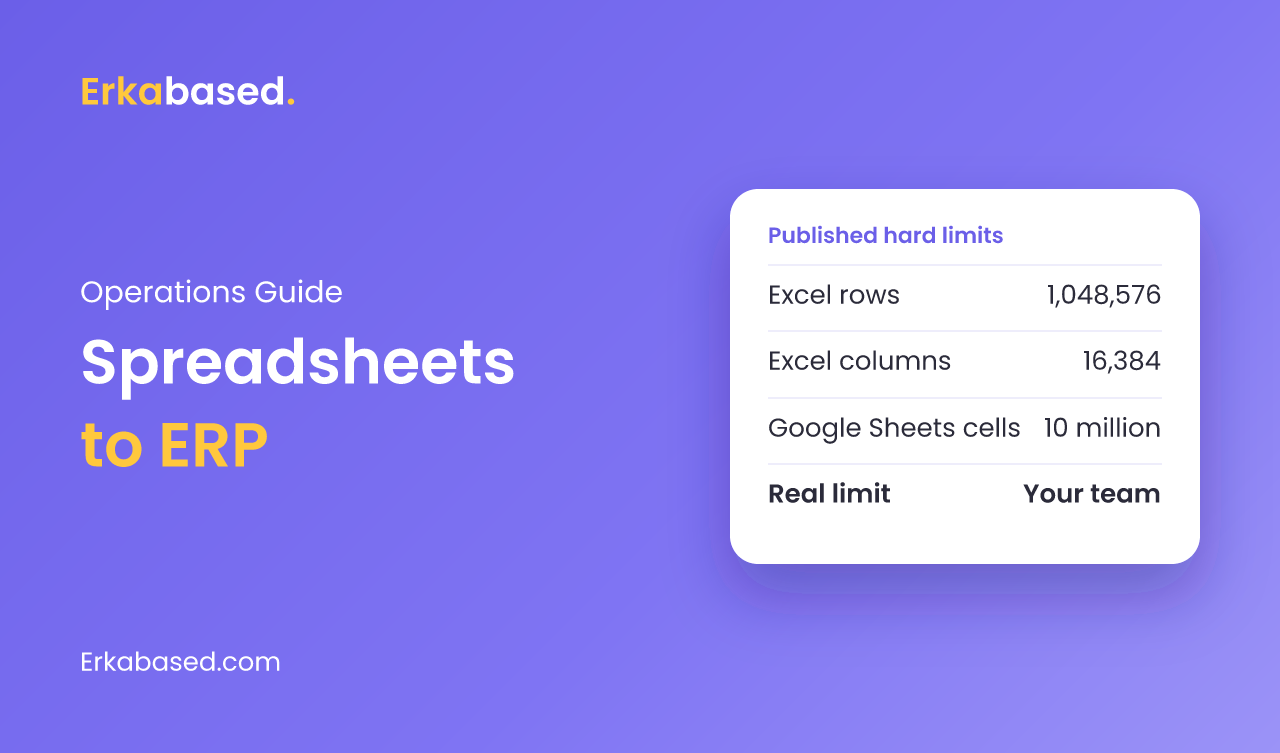
If you are coming from spreadsheets or a no-code stack, the same arithmetic applies. We walk through it in when to move from no-code to custom software.
Conclusion
Odoo is a strong choice for businesses whose processes look like everyone else's, and its pricing is refreshingly transparent. A custom ERP is the better investment when the valuable work happens in the gaps between channels, platforms, and teams. The mistake to avoid is buying a package and then rebuilding it module by module. Decide on fit first, then on price, and read more about inventory and purchasing systems and the benefits of custom software before you do.
Read next: moving from spreadsheets to an ERP, AI in ERP for small businesses, and our F&B backoffice case study.
Sources
- Odoo Pricing — Odoo, checked 19 September 2026
- Panorama Consulting Group Releases Latest Study of ERP Implementation Outcomes — Panorama Consulting Group, 4 March 2026
- Informasi Kurs JISDOR — Bank Indonesia, 18 September 2026
Frequently Asked Questions
How much does Odoo cost in 2026?
Odoo's pricing page lists a free plan for one app, a Standard plan, and a Custom plan, priced per user per month. For visitors in Indonesia on 19 September 2026, Standard was Rp137,500 and Custom Rp212,500 per user per month billed yearly, with lower first-year promotional prices. Implementation, custom code maintenance, and Odoo.sh hosting are not included.
When is a custom ERP better than Odoo?
A custom ERP is usually better when your most valuable workflows do not fit standard modules, or when the hard work happens between systems, such as reconciling marketplace or delivery-app settlements. If most of your requirements would become custom Odoo modules, a custom build is often cheaper to own over five years.
What are the hidden costs of Odoo?
Odoo's subscription does not cover implementation services, maintenance of custom code, Odoo.sh hosting for custom developments, or in-app purchase credits. Custom modules also need to be checked and updated when you upgrade to a new Odoo version.
How long does it take to build a custom ERP?
A focused first release of a custom ERP typically takes 4-12 weeks, covering the workflows that matter most. Further modules are added in later phases, which spreads the cost and lets your team adopt the system gradually.
Why do ERP projects go over budget?
Panorama Consulting Group's 2026 ERP Report found that more than a quarter of organizations exceeded their ERP budgets, with additional technology needs as the leading cause. Misfits between the software and the business are often discovered late, which leads to scope expansion and custom builds.
At Erkabased, we build custom ERP systems with AI features for businesses whose workflows do not fit a package: inventory, sales, production, finance, and dashboards in one place. A first release typically takes 4-12 weeks, and you receive the source code and server access. If you are weighing Odoo against a custom build, we are happy to review your workflow list with you. See our services or contact us.